

Alessia Onali

| Novel Thiazolidinone-Isatin Hybrids as Potent hCA IX Inhibitors Enhance Doxorubicin-Induced Apoptosis in Hypoxic Glioblastoma Cells |
| Onali Alessia1, Guarnieri Lorenza2, Bosco Francesca2, Lupia Antonio1, Sanna Erica1, Demuru Laura1, Atzeni Giulia1, Meleddu Rita1, Cottiglia Filippo1, Supuran T.Claudiu3, Distinto Simona1, Maccioni Elias1 1 Department of Life and Environmental Sciences, University of Cagliari, 09042 Monserrato, Italy 2 Section of Pharmacology, Department of Health Sciences, University “Magna Graecia” of Catanzaro, 88100 Catanzaro, Italy 3 Dipartimento NEUROFARBA, Sezione di Scienze Farmaceutiche, Università degli Studi di Firenze, Sesto Fiorentino, Florence, Italy |
| Abstract Carbonic anhydrase IX (hCA IX) is a HIF-1α-regulated transmembrane zinc-metalloenzyme overexpressed in hypoxic solid tumors, where it promotes extracellular acidification, invasive migration, and chemoresistance [1]. Its overexpression in glioblastoma multiforme (GBM) correlates with poor prognosis [2,3], yet no hCA IX inhibitor has reached clinical approval, underscoring the need for potent, isoform-selective compounds. Applying a molecular hybridization strategy based on the tail approach, we designed and synthesized a series of thiazolidinone-isatin hybrids (3a-i, 4a-i) featuring a benzenesulfonamide zinc-binding group coupled to an extended tail projected into the mid-cavity and entrance regions of the hCA IX active site. Enzymatic assays identified compound 3f as the most potent and selective hCA IX inhibitor (Ki = 8.6 nM; SI hCAI/IX = 631; SI hCAII/IX = 32.7). N-acetylation of the sulfonamide nitrogen completely abolished activity across all derivatives (Ki > 10,000 nM), confirming the free -SO₂NH₂ as strictly required for Zn²⁺ coordination. Molecular docking confirmed coordination of the catalytic zinc ion and key hydrogen bond interactions with Gln92, Thr199, and Thr200. In T98G glioblastoma cells, 3f (5 µM, non-cytotoxic as single agent) significantly sensitized cells to doxorubicin under both normoxic and chemically-induced hypoxic conditions (CoCl₂), reducing viability from ~76% to ~39%. Western blot analysis confirmed activation of the intrinsic apoptotic pathway, evidenced by increased Bax/Bcl-2 and cleaved caspase-3 ratios. These findings establish 3f as a promising lead for CA IX-targeted antitumor strategies in chemoresistant glioblastoma. 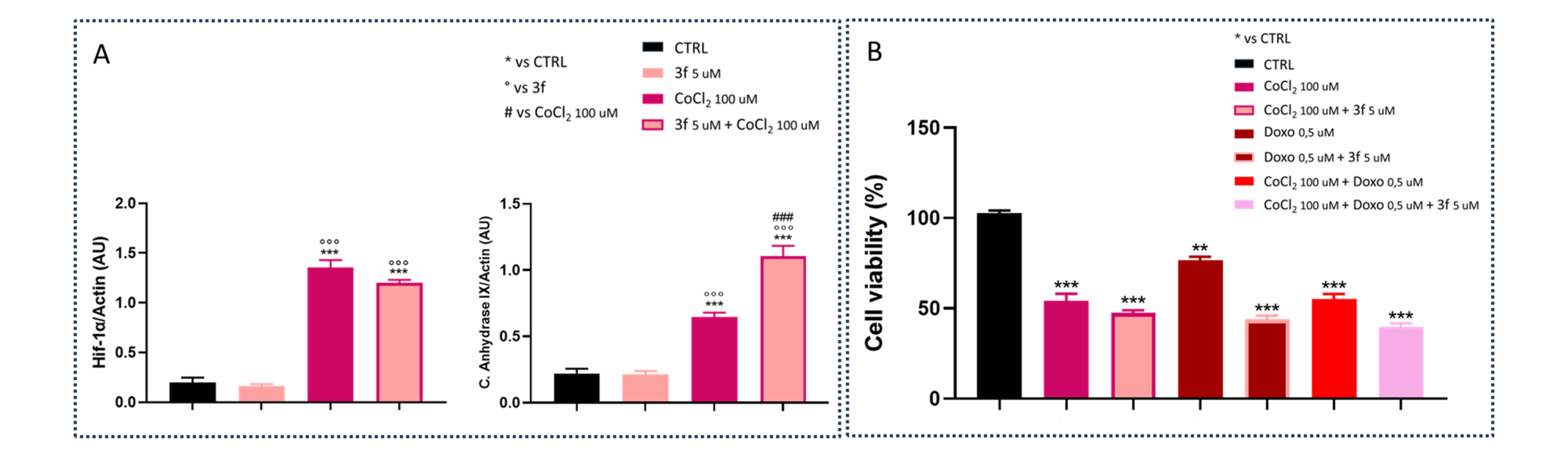 Figure 1. Hypoxia model validation and antiproliferative activity of 3f in T98G glioblastoma cells. Data are expressed as mean ± SEM. **p < 0.01, ***p < 0.001 vs CTRL. |
| References [1] Supuran, C.T., Carbonic anhydrase inhibitors and activators for novel therapeutic applications. Future Med Chem, 2011. 3(9): p. 1165-80. [2] Stupp, R., et al., Radiotherapy plus concomitant and adjuvant temozolomide for glioblastoma. N Engl J Med, 2005. 352(10): p. 987-96. [3] Proescholdt, M.A., et al., Function of carbonic anhydrase IX in glioblastoma multiforme. Neuro-Oncology, 2012. 14(11): p. 1357-1366. |