

Lorenzo Raffellini

| Targeting autophagy through ampk: design, synthesis, and biological evaluation of novel allosteric modulators |
| Lorenzo Raffellini1, Roberta Rocca2, Clementina Manera1, Sheraz Gul3, Stefano Alcaro2, Simona Rapposelli1 1 Department of Pharmacy, University of Pisa, Pisa, Italy. 2 Department of Health Science, “Magna Græcia” University of Catanzaro, Catanzaro, Italy. 3 Fraunhofer Institute for Translational Medicine and Pharmacology ITMP, Schnackernburgallee 114, 22525 Hamburg, Germany. |
| Abstract MP-activated protein kinase (AMPK) is a heterotrimeric serine/threonine kinase that serves as a central regulator of cellular energy homeostasis. Sensitive to fluctuations in intracellular AMP/ATP ratios, AMPK orchestrates a metabolic shift by promoting catabolic processes and inhibiting anabolic ones under energy-deprived conditions [1]. Among the various catabolic pathways regulated by AMPK, autophagy stands out as a pivotal mechanism for maintaining cellular homeostasis. This tightly regulated process of self-digestion ensures cellular survival by recycling damaged organelles and misfolded proteins, particularly under stress conditions such as nutrient deprivation, oxidative stress, or mitochondrial dysfunction [2]. Given its fundamental role in maintaining cellular homeostasis and integrity, impaired autophagy has been linked to the pathogenesis of diverse illnesses, including neuromuscular disorders, metabolic syndrome, and neurodegenerative diseases [3]. As such, pharmacological modulation of AMPK represents a promising strategy to restore autophagic flux and rescue tissue homeostasis to counteract disease progression. In light of the above, we designed a small library of benzimidazole-based derivatives capable of interacting with the allosteric drug and metabolite (ADaM) pocket of AMPK. After in-silico evaluation of the proposed structures through a docking study, we synthesized three series of potential ADaM binders. These novel compounds were then tested for their early-ADME-Tox and ecotox properties, with the aim of selecting the most promising ones for progression. Moreover, an in-vitro assay was performed to evaluate their potential to activate AMPK (Figure 1). 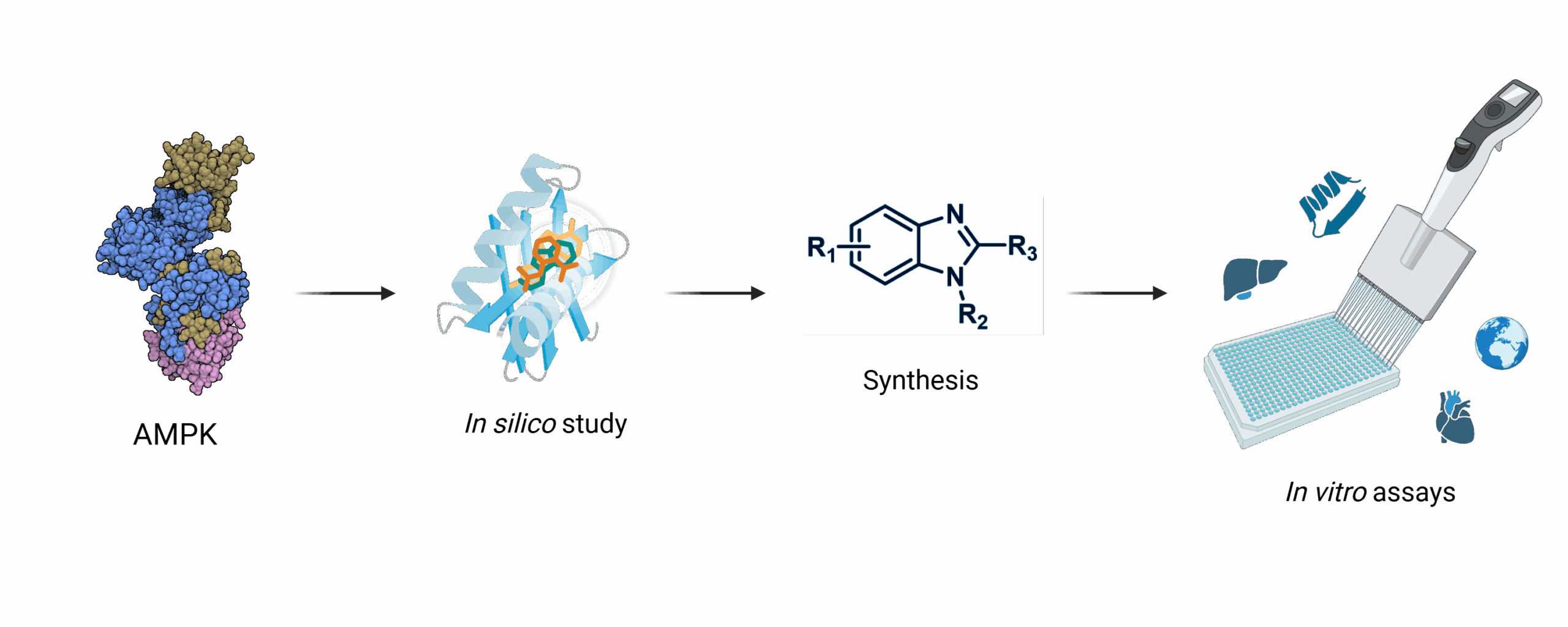 Figure 1. Workflow schematization. |
| References [1] Hardie, D.G.; AMP-activated/SNF1 protein kinases: conserved guardians of cellular energy. Nat Rev Mol Cell Biol 2007, 8, 774-785. [2] Glick, D., Barth, S. & Macleod, K. F. Autophagy: cellular and molecular mechanisms. The Journal of Pathology 2010, 221, 3-12. [3] Ichimiya T., Yamakawa T., Autophagy and Autophagy-Related Diseases: A Review. IJMS 2020, 21, 8974. |