

NEST Materials characterization WP 9.4_e
Materials testing and characterisation NEST spoke 9 WP 9.4
17 agosto 2025
The program NEST
NEST – Network 4 Energy Sustainable Transition – is one of the 14 major extended partnership projects selected by the Italian Ministry of University and Research (MUR), funded by the European Union – NextGenerationEU – as part of Mission 4, Component 2, Investment 1.3 of the National Recovery and Resilience Plan (PNRR). Its goal is to finance fundamental research projects to strengthen national research supply chains and promote their participation in strategic European and global value chains.
NEST spoke 9 Energy-sustainable advanced materials
The main objective is to develop advanced materials and technologies capable of improving device efficiency while reducing their carbon footprint, offering both environmental and economic benefits for energy applications. The aim is to create green synthesis protocols to enhance sustainability and minimize the environmental impact of processes. In addition, advanced techniques for chemical, structural, morphological, and functional characterization will be implemented to boost material performance and innovation.
The work within the NEST spoke 9 program is organized into several work packages (WP): WP 9.1 and WP 9.4, titled “Materials testing and characterisation.” The project led by the Surface Analysis, Electrochemistry, and Corrosion group is entitled “Multi-analytical approach for characterizing hydrogen permeation barriers (HPB).”
Project in WP 9.4: Multi-analytical approach for characterizing hydrogen permeation barriers (HPB)
Duration: From october 2022
Funding: Foundation NEST https://fondazionenest.it/
Responsible: Prof. A. Rossi, Dr. D. Biggio
The aim of the project is to develop an analytical protocol using a multi-analytical approach to understand, design, and monitor hydrogen diffusion and the functional properties of HPBs. This is achieved by combining both in-situ and ex-situ characterizations.
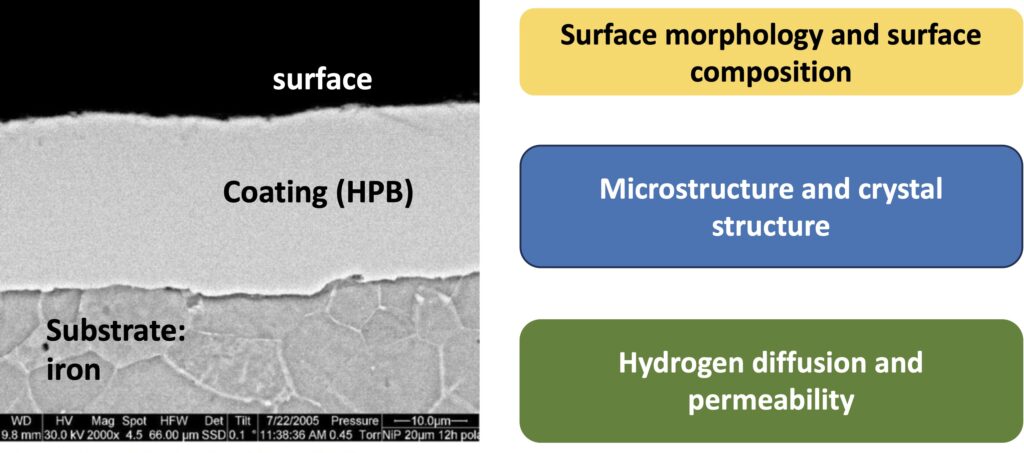
Microscopy, SEM and XPS analysis: characterization of surface composition and morphology
SEM and XRD analysis: characterization of the coating, thickness, microstructure, porosity, and other defects
Electrochemical test of hydrogen permeation using a double-cell setup
To disseminate this knowledge to a broad public, a MOOC (Massive Open Online Course) has been prepared by Dr. D. Biggio that can be used for exchange of information within the research project, professional development, or infor-mation of the public.