

Brass alloys historical instruments
Brass instruments of the 19th and early 20th centuries get more and more used to be played in historically informed performance practice. Monitoring of the corrosion state inside these historical brass instruments before and after being played is essential to check the efficiency of preventive conservation protocols. As corrosion of metal artifacts is an electrochemical process, electrochemical techniques are the method of choice, especially since nowadays these measurements can be carried out in situ and are non destructive. In order to interpret the “in situ” electrochemical measurements “ex situ” surface analytical methods such as XPS and XAES (X-ray excited Auger spectrospcopy) performed on brass surfaces in well defined conditions (after controlled exposure to known solutions) are essential. The influence of saliva composition has been studied.
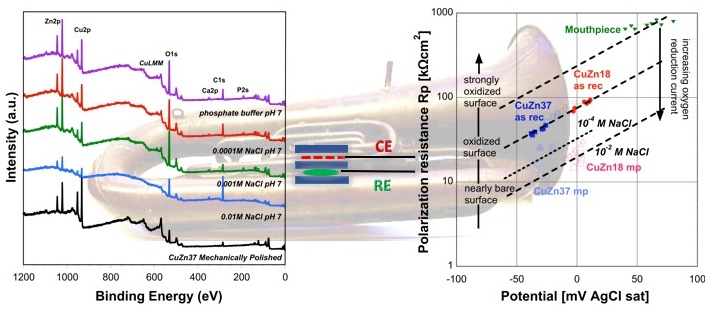
Surface analytical strategy by X-AES to identify the chemical state in copper and zinc >>>
Electrochemical sensor to measure corrosion rate inside the tuning slides >>>
Ageing of brass alloys in model electrolytes and in artificial saliva >>>
Influence of saliva composition on corrosion of brass alloys >>>
Publications:
- F. Cocco, B. Elsener, M. Fantauzzi, D. Atzei and A. Rossi, Nanosized Surface Films on Brass Alloys by XPS and XAES,
RSC Advances, 2016, 6, 31277 – 31289 DOI: 10.1039/C5RA23135C - F. Cocco, M. Fantauzzi, B. Elsener, A. Rossi, How Surface Analysis Can Contribute to an Understanding of the Preventive Conservation of Brass Instruments, in: To Play or Not to Play. Corrosion of Historic Brass Instruments. Romantic Brass Symposium 4, ed. by Adrian v. Steiger, Daniel Allenbach and Martin Skamletz, Schliengen: Argus 2023 (Musikforschung der Hochschule der Künste Bern, Vol. 15), pp. 73–82, doi.org/10.26045/kp64-6179-006
- B. Elsener, F. Cocco, M. Fantauzzi, S. Palomba and A. Rossi, Determination of the corrosion rate inside historical brass wind instruments – Proof of concept, Materials and Corrosion, 67 (2016) pp DOI: 10.1002/maco.201608996
- B. Elsener, M. Alter, T. Lombardo, M. Ledergerber, M. Wörle, F. Cocco, M. Fantauzzi, S. Palomba, A. Rossi, A non-destructive in-situ approach to monitor corrosion inside historical brass wind instruments , Microchemical Journal, Volume 124 (2016) 757-764 DOI: 10.1016/j.microc.2015.10.027
- A v. Steiger, D. Allenbach, M. Ledergerber, B. Elsener, D. Mannes, T. Lombardo, F. Cocco, M. Fantauzzi, A. Rossi, M. Skamletz, M. Miirner, M. Wöhrle, E. Cornet, E. Lehmann, New Insights into the Conservation of Brass Instruments: Brass Instruments between Preventive Conservation and Use in Historically Informed Performance, Historical Brass Society Journal 30 (2018) 85-102 DOI: 10.2153/0120180011005
- B. Elsener, T. Lombardo, F. Cocco /M. Fantauzzi, M. Wörle, A. Rossi, Breathing New Life into Historical Instruments. How to Monitor Corrosion, In To Play or Not to Play. Corrosion of Historic Brass Instruments. Romantic Brass Symposium 4, ed. by Adrian v. Steiger, Daniel Allenbach and Martin Skamletz, Schliengen: Argus 2023 (Musikforschung der Hochschule der Künste Bern, Vol. 15), pp 61 – 72 (2022) DOI:10.26045/kp64-6179-005
- F. Cocco, M. Fantauzzi, B. Elsener, A. Rossi, Dissolution of brass alloys naturally aged in neutral solutions – an electrochemical and surface analytical study, RSC Advances 6 (2016) 90654 – 90665 DOI 10.1039/C6RA18200C
- D. Biggio, B. Elsener, D. Atzei, A. Rossi, M. Fantauzzi, The effect of the saliva formulation on brass corrosion, Materials and Corrosion 74 (2023) 269 – 276. doi:10.1002/maco.202213476