

Manganese removal by marble waste – mechanism by XPS
Powdered marble waste (MW) resulting from cutting processes in the Orosei marble district is tested as sorbent for toxic elements from wastewater in compliance with the European circular economy strategy. MW consists of a calcite polymorph of CaCO3 with a Mg content of about 0.28 wt%. This article focuses on surface analysis by X-ray photoelectron spectroscopy (XPS) of MW used as sorbent, combined with solution analysis by inductively coupled plasma atomic emission spectroscopy (ICP-AES). The goal is to distinguish between different removal mechanisms of Pb2+ and Mn2+ from model solutions over a wide concentration range, from 0.1 μM to 100 mM.
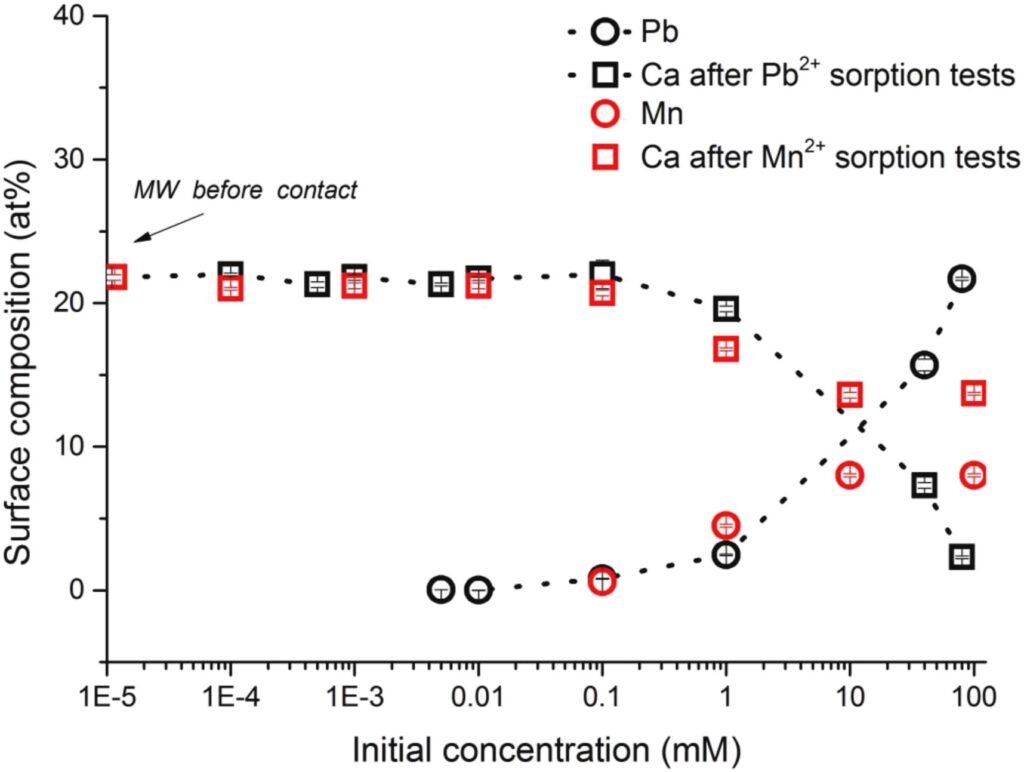
Surface lead, manganese and calcium concentrations (at%) from XPS data, following lead and manganese sorption tests.
The results showed a removal efficiency (RE) of about 100% for Pb, independent of the initial concentration, and up to about 100% for manganese, providing its initial concentration is lower than 0.1 mM. These findings help in the development of remedial processes and analytical strategies for water remediation.
Publication: E. Fiorito, M. Fantauzzi, L. Brundu, D. Atzei, B. Elsener, A. Rossi, Spectroscopic evidence for clarifying the mechanism of toxic element removal by marble waste, Vacuum 196 (2022) 110721 doi: 10.1016/j.vacuum.2021.110721