

e.INS spoke 7 low carbon technologies

Study of hydrogen permeation barriers for the safe storage and transport of green hydrogen
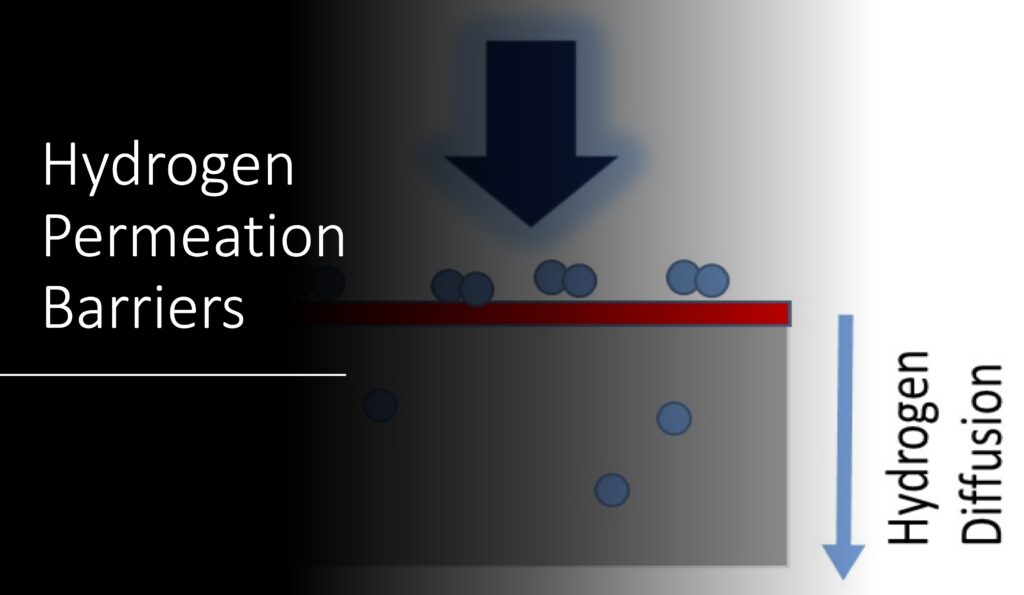
The project led by the Surface Analysis, Electrochemistry, and Corrosion group, titled “Study of hydrogen permeation barriers for the safe storage and transport of green hydrogen”, is part of e.INS spoke 7, within WP2 – Green Hydrogen and Fuels, specifically under Task T2.1 – Green Hydrogen Production and Task T2.2 – Green Fuels and Carbon Sequestration.
Responsible: Prof. A. Rossi
Publications:
- R. Hannachi, D. Biggio, B. Elsener, M. Fantauzzi, N. Zaccchetti, A. Rossi, A Surface Analytical Method for Determining the Porosity of Tungsten Coatings as Hydrogen Permeation Barriers, Surface and Interface Analysis (2025) doi: 10.1002/sia.70027
- R. Hannachi, D. Biggio, B. Elsener, M. Fantauzzi, N. Zacchetti, A. Rossi, A Contribution of XPS and Electrochemistry to the Understanding of Hydrogen Diffusion in X60 Steel, Coatings 15 (2025) 442 doi: 10.3390/coatings15040442
- R. Hannachi, D. Biggio, B. Elsener, M. Fantauzzi, A. Rossi, X-ray photoelectron spectroscopy investigation of X60 steel, Surface Science Spectra 31 (2024) 024014. doi:10.1116/6.0003972
Oral and poster presentations:
- R. Hannachi, D. Biggio, B. Elsener, M. Fantauzzi, N. Zachetti, A. Rossi, Tungsten-coating as hydrogen permeation barrier on X60 steel, XXVIII Congresso Nazionale Società Chimica Italiana SCI, Milano 26 – 30 August 2024. ANA-PO-080
- R. Hannachi, D. Biggio, B. Elsener, M. Fantauzzi, A. Rossi, Tungsten coating on steel as hydrogen permeation barrier: a surface characterization, ECASIA’24 European conference on applications of surface and interface analysis, ECASIA 2024, Goteborg Sweden, from June 9 to June 14, 2024 page 284
- R. Hannachi, B. Elsener, M.Fantauzzi, A.Rossi, Functional properties of hydrogen permeation barriers on steel, XXX Conference of Analytical Chemistry – Italian Chemical Society, Vasto Chieti, Italy, from September 17-21, 2023.
Further informations on e.INS Ecosystem of Innovation for Next generation Sardinia:
The project e.INS Ecosystem of Innovation for Next generation Sardinia
e.INS – Ecosystem of Innovation for Next generation Sardinia is a program to strengthen the link between business and science, mitigate the social impacts generated by the crisis and increase the level of territorial inclusion. It is designed to support innovation processes and promote their dissemination, facilitate the transfer of technologies to the production system, involve local communities in the challenges of sustainable innovation and guide the territory towards a truly knowledge-based economy.
web-site of the project e.INS: https://www.einssardinia.it/en.php
Project funded under the NATIONAL RECOVERY AND RESILIENCE PLAN (PNRR) – MISSION 4 COMPONENT 2, “From research to business” INVESTMENT 1.5, “Creation and strengthening of Ecosystems of innovation” and construction of “Territorial R&D Leaders”
Organisation of the project – thematic areas of the spokes
The Hub is responsible for the launch, implementation and management of the ecosystem which is organized around 10 thematic Spokes. 18 subjects of both public and private nature will operate synergistically in different roles (Hub members, spoke coordinators, spoke affiliates). The constellation of the partnership has been selected to operate effectively in the key sectors of the Sardinian economy.
The thematic areas of the spokes represent the synthesis of the main economic sectors of the region around which, historically, Sardinian scientific research has been focused: Medicine, Tourism and Cultural Heritage, AgriVet, Finance and Credit services to the territory and enterprises, Aerospace, Energy, Digital, Mobility, Environmental Heritage, Biopharmacology.
Spoke 7: Low carbon technologies for efficient energy systems, WP2 – Green hydrogen and fuels
The research activity carried out in the framework of WP2 regards two different topics concerning respectively the Task T2.1 – Green hydrogen production and demonstrator and the Task T.2.2 – Green fuels and carbon sequestration. Leader of WP2 Prof. Giorgio Cau.
The overall research activity carried out within WP2 involves two departments, the Department of mechanical, chemical and materials engineering (DIMCM) and the Department of chemical and geological sciences (DSCG), with three research groups, two relating to the DIMCM (chemical engineering and mechanical engineering groups) and five to the DSCG. The two research groups of DIMCM are mainly involved in the Task T2.1, the research groups of DSCG in both the Task T2.1 and T2.2.
The research groups of the Department of Chemical and Geological Sciences are composed as following:
- Antonella Rossi, professor, (critical mass) in collaboration with Prof. Marzia Fantauzzi and Prof. Bernhard Elsener
- Elisabetta Rombi, associate professor, (critical mass)
- Maria Laura Mercuri, associate professor (critical mass)
- Annalisa Chiappone, associate professor (critical mass)
- Fausto Secci, fixed-term research assistant hired last September, funded by the e.INS project