

Electrochemical and XPS surface analytical studies on the reactivity of enargite
Enargite, a copper arsenic sulfide having the formula Cu3AsS4, is a source of arsenic and may cause environmental problems owing to the release of toxic elements upon oxidation, especially in acid mine effluents. In this work the oxidative dissolution of enargite has been studied on freshly cleaved samples exposed to distilled water, sulfuric acid solution at pH 4 and acidic FeCl3 or Fe2(SO4)3 solutions at pH ca. 2 with 0.025 M Fe3+ simulating abiotic acid mine drainage environments.
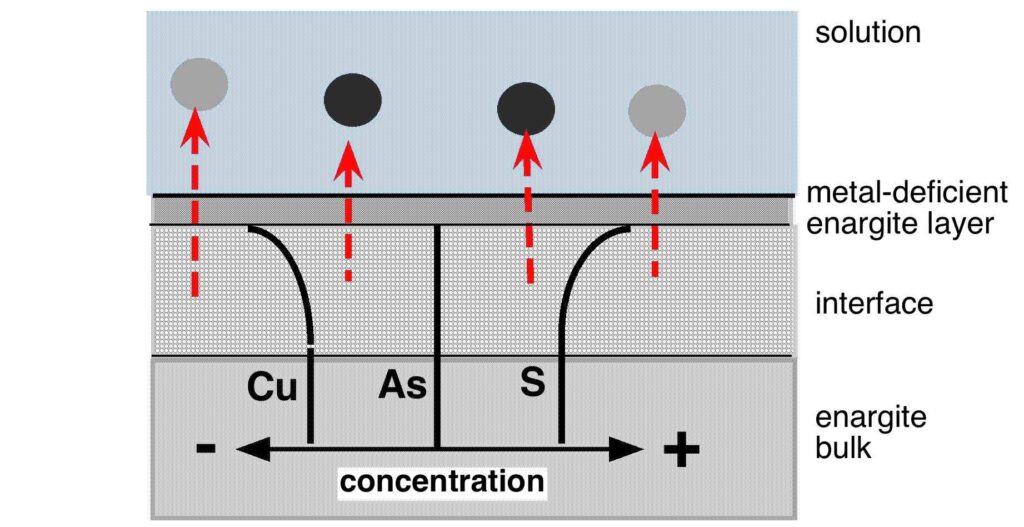
A prominent sulfur signal appeared at ca. 163.5 ± 0.2 eV, assigned to sulfur in a copper-deficient layer. The XPS quantitative analysis performed by applying a three-layer model revealed the presence of a metal-deficient layer of ca. 0.7 nm thickness on the enargite surface. The interface beneath this layer (estimated thickness 5 – 10 nm) was slightly enriched in sulfur and depleted in copper. Based on these complementary data from solution analysis and XPS surface analysis, a model similar to the dissolution of binary metallic alloys is here proposed for enargite dissolution under oxidizing conditions.
The open circuit potential of the acidic solutions with ferric ions achieved stabilization after 24 h at + 0.72 ± 0.02 V NHE thus, according to the mixed potential theory, the redox couple Fe3+/Fe2+ strongly polarizes the enargite surface towards positive potentials.
Solution analyses showed that in these conditions about 10 – 14 µg copper are released in the first 24 hours into solution from approximately 0.5 cm2 enargite surface. Based on the amount of dissolved copper, the thickness of the dissolved enargite has been calculated to be about 60 – 130 nm.
A model for the stationary dissolution of enargite has been proposed: on top of the enargite surface, a thin metal deficient enargite surface layer is formed. The interface beneath this layer is slightly enriched in sulfur and depleted in copper, arsenic shows the nominal composition. This layered interface with a change in the surface concentratoin of sulfur and copper enables homogeneous dissolution of enargite in stoichiometric ratio.
Publications:
B. Elsener, D. Atzei, M. Fantauzzi, A. Rossi, Electrochemical and XPS Surface Analytical Studies on the Reactivity of Enargite, European Journal of Mineralogy, 19 (2007) 353 – 361 DOI 10.1127/0935-1221/2007/0019-1729