

Electronic structure
Effect of phosphorus concentration on the electronic structure of Ni-P nanocrystalline alloys
A series of electrodeposited nickel-phosphorus alloys ranging from 6 to 29 at% of phosphorus have been analyzed by surface analysis using x-ray photoelectron spectroscopy (XPS) and x-ray excited Auger electron spectroscopy (XAES). It has been found that all the core level binding energies as Ni2p3/2 and Ni2p1/2, P2p, P2s as well as the x-ray excited Auger lines NiLMM and PKLL remained constant irrespective of the phosphorus concentration in the alloys. The only systematic differences observed were:
- a) the binding energy of the satellite in the Ni2p signals,
- b) the fine structure of the NiLMM Auger lines,
- c) the percentage of the satellite in the total Ni2p3/2 spectrum and
- d) the density of states in the valence band in the region of the Ni3d electrons,
All these parameters are related to the electronic structure of the Ni-P alloys. It is the first time that the influence of ligand concentration (here phosphorus) on the electronic structure of the nickel based alloys could be described and rationalized with a screening model proposed in literature for clarifying the role of the substituents on the electronic structure of conducting nickel compounds.
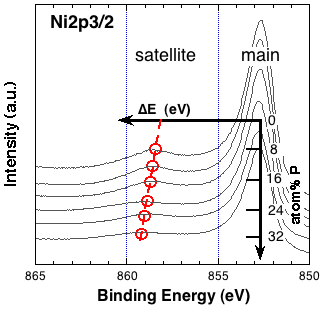
The XPS Ni2p and P2p core lines as well as the x-ray induced Auger PKLL and NiLMM remain constant irrespective of the phosphorus content (6 – 29 at%) in the sputtered Ni-P alloys. This indicates that the phosphorus content does not induce changes in the formal net charge on P and Ni atoms in the alloy. Only the systematic varriation of the binding energy difference between the two states in the Ni2p spectra (Ni2p3/2 main peak and its satellite, see figure) indicates a change in the electronic structure of the alloy with increasing phosphorus content.
It is proposed that increasing phosphorus content in electrodeposited, sputter cleaned Ni-P alloys leads to a decreasing number of non-bonding Ni3d electrons, thus the screening of the core hole is less pronounced and the binding energy of the satellite associated to the final state with a filled Ni4s shell increases. The lower number of “metallic” non-bonding Ni3d electrons results in a lowered screening of the valence band region, hence a deeper potential well after core hole formation, and explains the increasing binding energy difference of the final state Ni2p satellite peak with increasing phosphorus content.
Publication: B. Elsener, A. Krolikowski, D. Atzei, A. Rossi, Effect of phosphorus concentration on the electronic structure of Ni-P nanocrystalline electrodeposited alloys: an XPS / XAES study, Surface and Interface Analysis 40 (2008) 919 – 926 doi 10.1002/sia.2802