

Electrochemical Sensor
Brass instruments of the 19th and early 20th centuries get more and more used to be played in historically informed performance practice. Monitoring of the corrosion state inside these historical brass instruments before and after being played is essential to check the efficiency of preventive conservation protocols. As corrosion of metal artifacts is an electrochemical process, electrochemical techniques are the method of choice, especially since nowadays these measurements can be carried out in situ and are non destructive.
An electrochemical sensor has been tested on brass reference samples and applied on a mouthpiece of a historical brass instrument. Using a phosphate buffer solution pH 7 with 0.001 M NaCl, the electrochemical response (open circuit potential, polarisation resistance) of the sensor corresponds to the results obtained in a traditional electrochemical cell. XPS surface analysis has shown that the brass surface composition after 7 min contact with the sensor is not altered when using 0.001 M NaCl. The sensor is fit for purpose and has already been applied in brass wind instruments.
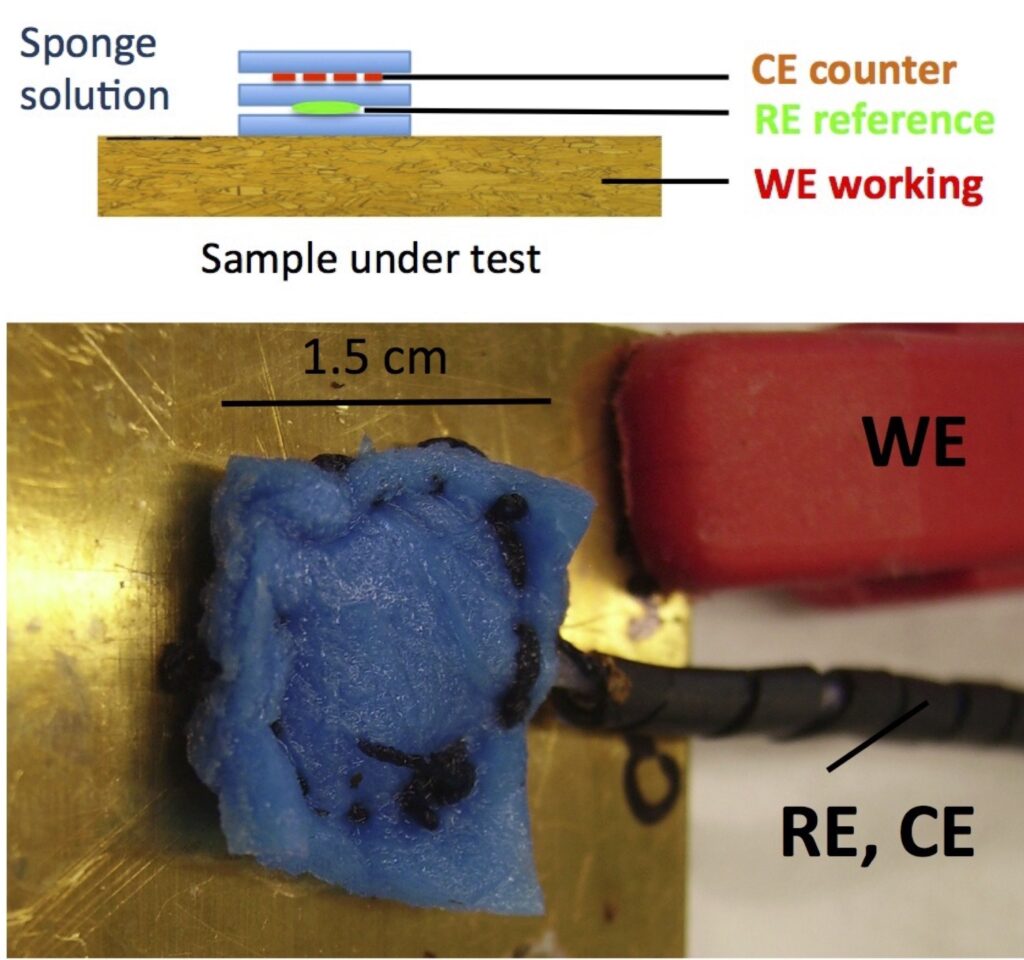
The electrochemical sensor has proven to work well in historical brass instruments, especially inside the tuning slides, both for open circuit potential (OCP) and polarization resistance (Rp) measurements. Open circuit potentials alone reveal differences of the surface in the artifacts that only in some cases can be related to features in the endoscope picture, a full interpretation of the surface state is not possible.
A diagnostic representation “log Rp vs OCP” allows rationalize the measured OCP/Rp data in the context of XPS surface analytical results obtained in well controlled laboratory experiments. The surface state and the instantaneous corrosion rate of the artifacts can be assessed by means of OCP/Rp in-situ measurements.
The procedure presented in this paper and the results obtained are very important for conservators for achieving the relevant information on the corrosion state and rate inside the instruments and to control the efficiency of preventive conservation measures.
Publications:
B. Elsener, F. Cocco, M. Fantauzzi, S. Palomba and A. Rossi, Determination of the corrosion rate inside historical brass wind instruments – Proof of concept, Materials and Corrosion, 67 (2016) pp DOI: 10.1002/maco.201608996
B. Elsener, M. Alter, T. Lombardo, M. Ledergerber, M. Wörle, F. Cocco, M. Fantauzzi, S. Palomba, A. Rossi, A non-destructive in-situ approach to monitor corrosion inside historical brass wind instruments , Microchemical Journal, Volume 124 (2016) 757-764 DOI: 10.1016/j.microc.2015.10.027
A v. Steiger, D. Allenbach, M. Ledergerber, B. Elsener, D. Mannes, T. Lombardo, F. Cocco, M. Fantauzzi, A. Rossi, M. Skamletz, M. Miirner, M. Wöhrle, E. Cornet, E. Lehmann, New Insights into the Conservation of Brass Instruments: Brass Instruments between Preventive Conservation and Use in Historically Informed Performance, Historical Brass Society Journal 30 (2018) 85-102 DOI: 10.2153/0120180011005
B. Elsener, T. Lombardo, F. Cocco /M. Fantauzzi, M. Wörle, A. Rossi, Breathing New Life into Historical Instruments. How to Monitor Corrosion, In To Play or Not to Play. Corrosion of Historic Brass Instruments. Romantic Brass Symposium 4, ed. by Adrian v. Steiger, Daniel Allenbach and Martin Skamletz, Schliengen: Argus 2023 (Musikforschung der Hochschule der Künste Bern, Vol. 15), pp 61 – 72 (2022) DOI: 10.26045/kp64-6179-005