

X-AES of copper and zinc
Nanosized surface films on brass alloys by XPS and XAES
A new analytical strategy for simultaneous chemical state identification and quantification of copper and zinc in complex, thin-layered systems is presented. This approach is based on the curve fitting of the multicomponent X-ray excited Auger spectra, CuLMM and ZnLMM, that clearly distinguish metallic and oxide components and result in separated intensities of metallic and oxidized peak areas. On reference copper and zinc compounds, showing only a single chemical state, the intensity ratio R between photo-electron and Auger intensity was determined. A quantification factor, k = Rox/Rmet, was calculated for both copper and zinc. This quantification factor k is independent of the instrument employed for the analysis, as proved here by using different spectrometers. The factor k is then used to transfer the experimental Auger intensity ratio into the XPS intensity ratio, which is required for the quantitative analysis by XPS. The potential of this approach based on XPS and XAES for the patina studies on copper alloys, relevant in various fields including corrosion and cultural heritage, is presented for Cu37Zn model brass alloy after different surface pre-treatments. This approach has proven to be successful. The following conclusions can be drawn from this surface analytical work:
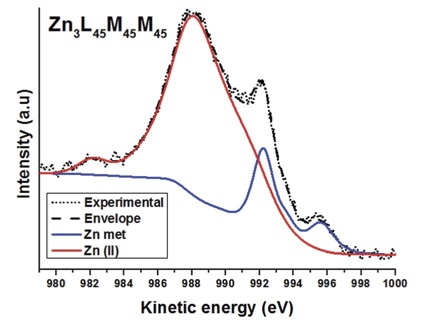
(1) A new analytical strategy for simultaneous chemical state identification and quantification of copper and zinc in complex, thin-layered systems has been established.
(2) Curve fitting of the multicomponent X-ray excited Auger spectra of copper CuLMM and zinc ZnLMM allows the discrimination of the different chemical states (e.g. metallic and oxide components) in complex systems.
(3) Standards of pure metals and oxides are essential to accurately determine the envelopes of the complex Auger signals for curve fitting and to calculate the experimental intensity ratios between photoelectron and Auger intensity required for quantification.
The new analytical approach for quantification has been tested on Cu37Zn model brass alloys after different surface pretreatments and has proven to be successful.
Publications:
F. Cocco, B. Elsener, M. Fantauzzi, D. Atzei and A. Rossi, Nanosized Surface Films on Brass Alloys by XPS and XAES,
RSC Advances, 2016, 6, 31277 – 31289 DOI: 10.1039/C5RA23135C
F. Cocco, M. Fantauzzi, B. Elsener, A. Rossi, How Surface Analysis Can Contribute to an Understanding of the Preventive Conservation of Brass Instruments, in: To Play or Not to Play. Corrosion of Historic Brass Instruments. Romantic Brass Symposium 4, ed. by Adrian v. Steiger, Daniel Allenbach and Martin Skamletz, Schliengen: Argus 2023 (Musikforschung der Hochschule der Künste Bern, Vol. 15), pp. 73–82, doi.org/10.26045/kp64-6179-006