


The Course is divided into three paths and aims to train students to acquire specific theoretical and methodological skills for the design and implementation of qualified research activities. This will also allow students to define and analyze the relationships between specific issues and other fields of philosophical research, as well as those of other disciplines, both in the scientific and humanistic fields. Its objective is therefore to provide a path of specialization that ensures highly specific skills in the diverse range of knowledge and expertise. These skills, however, do not confine research to a narrow specialized horizon, but rather enable students to grasp its relationships with other disciplines and methodologies and, on this basis, enable them to promote and develop fruitful interaction between them. These skills will therefore be primarily focused on identifying and developing transversal or multidisciplinary themes, even across the component path.
The offered training aims to meet the need for transversal skills across diverse research fields, providing conceptual and methodological tools for a critical and interdisciplinary approach to problems. The program, while primarily preparing students for highly qualified research, can facilitate placements in organizations that address complex phenomena, human resources management, new technologies, and the design and evaluation of interventions for the development of individual and collective potential. The program’s highly multidisciplinary and interdisciplinary nature enables the training of professionals capable of engaging in dialogue between even very distant professional fields: the skills developed lend themselves to the broadest possible application and implementation in various cultural, social, communication, information, and educational contexts.
The skills acquired lead to employment opportunities at universities, public, and private institutions, in theoretical and applied research on cultural planning, information processing and knowledge communication, and intervention design in educational, clinical, and community settings, as well as in the inclusion of diversity.
Paths
- Philosophy and History of Concepts
This section addresses issues and methodologies of theoretical research, with reference to models of rationality rooted in tradition. It also analyzes the processes of preservation and transmission of knowledge through the circulation of ideas, in the interplay between philosophical doctrines, scientific theories, artistic and cultural experiences, and social and political practices. - Logic and Epistemology
This section focuses on issues related to logic, the foundations, and formal analysis of the deductive, natural, and human sciences. Issues related to artificial intelligence, information theory, and the communication of scientific content are also considered. - Pedagogical and Psychological Sciences
This section addresses issues and methodologies of pedagogy in its historical and theoretical-foundational development, of teaching and educational research, and of social, developmental, and clinical psychology across the life cycle. It measures and evaluates the developmental trajectories of typical and atypical mental processes (motivation, attachment and intersubjectivity, metarepresentation, theory of mind, language), promoting training in the inclusion of diversity in educational and community contexts.
Headquarters
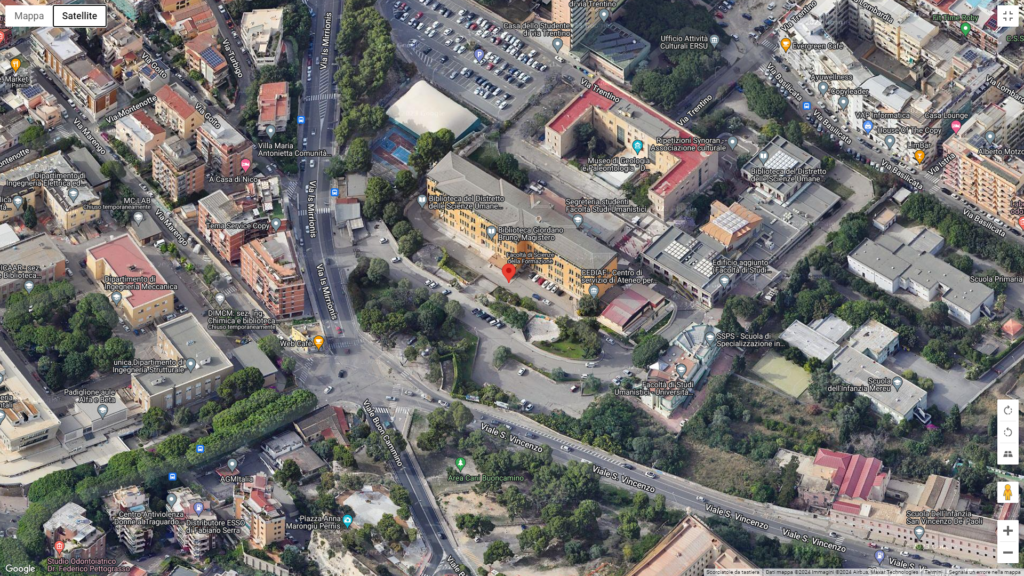
Campus Sa Duchessa, Facoltà di Studi Umanistici
via Is Mirrionis 1, Cagliari 09123
Teaching activities take place in spaces designated by the organizers and indicated in the course offerings. A dedicated classroom, “Aula Dottorandi” (Doctoral Students’ Room), is also available, equipped with workstations, Wi-Fi internet connection, a large screen for conferences, and a sound system.
Administration
Notices
News

28-29/09/2026: Workshop “Quantum & Quantum-Inspired Machine Learning – Intersections and New Frontiers”.
Starting at 9.30, September 28, rooms 5 & 6,
Main building, Campus Sa Duchessa, via Is Mirrionis 1, Cagliari.
Invited Speakers
- Prof. Alessandra Di Pierro- University of Verona
- Prof. Carla Piazza- University of Udine
- Prof. Giuseppe Serra- University of Udine
Organizers
- Prof. Roberto Giuntini
- Prof. Giuseppe Sergioli
- Dr. Andrés Camilo Granda Arango
- Dr. Carlo Cuccu

27/10 – 04/11 – 12/11 – 17/11/2026: Seminars on “New Approaches to Landscape”
“Corpo Aggiunto” Building, Sa Duchessa Campus, Via Is Mirrionis 1, Cagliari
Organized by Luca Vargiu
- October 27. Giovanni Gamberi (Center for Far Eastern Art Studies, Bologna): Light in the Chinese Landscape. Room 4A, 5:00 PM – 8:00 PM.
- November 4. Irene Galuppo (PhD Candidate in Visual Arts, Music, and Creative Practices, Academy of Fine Arts of Naples): From Landscape to Walkscape: The Frontier Landscape in the Artistic Practices of Francis Alÿs. Room 9A, 5:00 PM – 8:00 PM.
- November 12. Raffaele Digirolamo (PhD in Historical and Philosophical Heritage for Sustainable Innovation, University of Bari Aldo Moro): Landscape as a Perceptual Phenomenon. Room 7A, 5:00 PM – 8:00 PM.
- November 17. Giuseppe Floris (Master’s in Environmental Humanities, Roma Tre University): Rethinking Landscape Beyond Anthropocentrism: From Geophilosophy to Environmental Humanities. Room 4A, 5:00 PM – 8:00 PM.