

Hydrothermal Carbonization (HTC)
A thermochemical process for converting wet biomass into hydrochar under subcritical water conditions
✍️ by Nicole Berge and Gianluigi Farru
History & Development
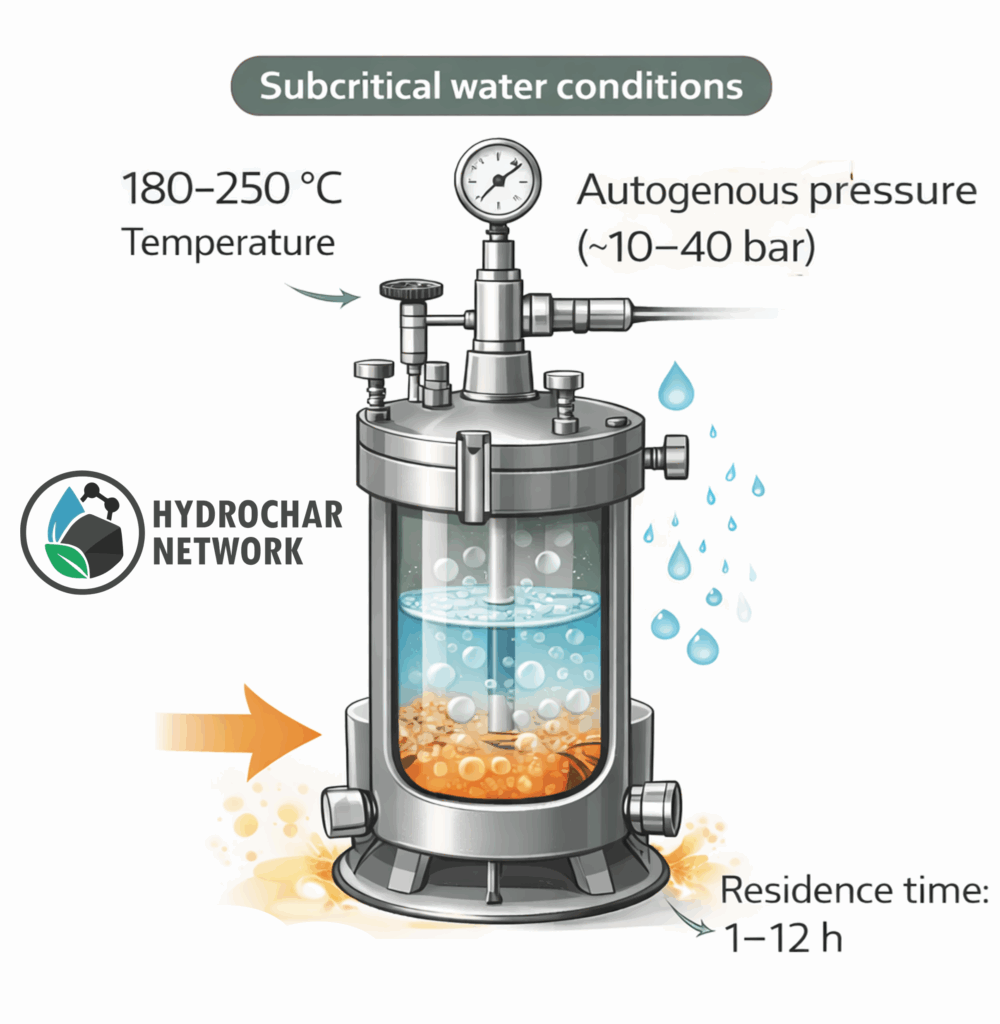
The conceptual origins of hydrothermal carbonization (HTC) trace back to early 20th-century work by Friedrich Bergius, who investigated coal formation under hydrothermal conditions. Modern HTC research re-emerged in the early 2000s with renewed interest in biomass valorization and wet waste treatment (Libra et al., 2011; Funke & Ziegler, 2010). Hydrothermal carbonization is a thermochemical conversion process that transforms wet organic feedstocks into a carbon-rich solid product known as hydrochar, along with a liquid phase containing dissolved organic compounds and a gaseous phase dominated by carbon dioxide (Libra et al., 2011; Funke & Ziegler, 2010). The process is conducted in liquid water at elevated temperatures, typically between 180 and 250 °C, in a closed reactor under autogenous pressure generated by heating water above its boiling point. Unlike dry thermochemical processes such as pyrolysis, HTC operates in an aqueous environment and enables direct processing of high-moisture materials such as sewage sludge, digestate, and food waste without prior drying. Water functions simultaneously as solvent, reactant, and heat-transfer medium, promoting chemical pathways that are suppressed under dry conditions (Berge et al., 2011; Funke & Ziegler, 2010).
Theory & Mechanisms
HTC converts biomass through a combination of hydrolytic and carbonization reactions occurring in subcritical water. Early stages are dominated by solubilization and depolymerization of biopolymers, followed by secondary reactions that concentrate carbon in the solid phase (Libra et al., 2011). Water facilitates bond cleavage, stabilizes reactive intermediates, and enables homogeneous heat transfer. As reaction severity increases, the solid product progressively evolves toward lower hydrogen-to-carbon (H/C) and oxygen-to-carbon (O/C) atomic ratios, indicating increasing carbonization (Funke & Ziegler, 2010).
Process Chemistry & Mechanisms
HTC proceeds through a network of overlapping and parallel reactions rather than a single dominant pathway:
- Hydrolysis breaks down polymeric components such as cellulose, hemicellulose, and proteins into soluble oligomers and monomers (Funke & Ziegler, 2010).
- Dehydration removes hydroxyl groups, releasing water and increasing carbon density in reaction intermediates.
- Decarboxylation eliminates carboxyl functional groups, primarily as CO₂, reducing oxygen content.
- Condensation and polymerization recombine reactive intermediates (e.g., furans, phenolics) into larger macromolecular structures that precipitate as hydrochar.
- Aromatization leads to increasingly stable aromatic domains as temperature and residence time increase.
These transformations are commonly visualized using van Krevelen diagrams, where HTC products shift toward regions associated with coal-like materials (Sevilla & Fuertes, 2009; Román et al., 2018).
Thermodynamics, Kinetics & Parameters
Key reaction steps in HTC, particularly dehydration and decarboxylation, are generally exothermic, although the overall energy balance depends on system heat recovery (Funke & Ziegler, 2010). Apparent kinetics are often described using lumped or first-order models, but the process is inherently multi-step and strongly dependent on feedstock composition and operating conditions (Román et al., 2018). Organic acids generated in situ (e.g., acetic acid) commonly lower system pH and exert an autocatalytic effect, accelerating further conversion reactions (Berge et al., 2011).
Key variables influencing HTC performance include:
- Temperature: Typically 180–250 °C; higher temperatures promote dehydration, aromatization, and carbon densification (Libra et al., 2011).
- Pressure: Autogenously generated pressure sufficient to maintain water in the liquid phase.
- Residence time: Ranges from minutes to several hours and is largely dictated by desired end-product characteristics; longer times increase carbonization but often reduce solid yield (Román et al., 2018).
- Feedstock characteristics: Chemical characteristics of the feedstock (e.g., carbon, lignin, ash) strongly influence reaction pathways and hydrochar properties (Berge et al., 2011).
- Solid loading: Affects heat and mass transfer and product partitioning.
- pH and additives: While HTC proceeds without additives, acids, bases, or salts may alter reaction rates and selectivity (Funke & Ziegler, 2010).
Hydrochar, Byproducts & Energy
Hydrochar is an amorphous to partially aromatic carbonaceous solid containing oxygen-bearing functional groups such as hydroxyl and carboxyl moieties. Compared with pyrolysis biochar, hydrochar typically exhibits higher residual oxygen content, lower initial aromaticity, and a less developed pore structure prior to activation (Sevilla & Fuertes, 2009; Román et al., 2018). Characterization techniques include elemental analysis, FTIR spectroscopy, Raman spectroscopy, and solid-state NMR (Libra et al., 2011).
The aqueous phase generated during HTC contains short-chain organic acids (e.g., acetic and formic acid), sugars, furans, phenolics, and nitrogen-containing species (Weiner et al., 2014). This process water typically exhibits high chemical oxygen demand (COD) and requires treatment prior to discharge. Management strategies include anaerobic digestion for methane recovery or integration with wastewater treatment systems (Berge et al., 2015).
Energy & Sustainability Aspects
HTC is frequently evaluated within integrated waste-management and bioeconomy systems due to its ability to process wet feedstocks without energy-intensive drying. Life-cycle assessments indicate that environmental performance depends strongly on heat integration, hydrochar end use, and management of the aqueous phase (Lucian & Fiori, 2017). Recent reviews emphasize that favorable sustainability outcomes require coupling HTC with appropriate valorization or treatment pathways rather than considering hydrochar production in isolation (Ischia et al., 2024). Table 1 provides a concise overview of the key operational parameters and features of HTC.
| Temperature | Pressure | Residence Time | Main Product | Preferred Feedstocks |
|---|---|---|---|---|
| 180 – 250 °C | Autogenous | <1 – >12 h | Hydrochar | Biomass, sludge, wet wastes with moisture contents > 20% (wet wt.) |
📖 References
Berge, N. D., Ro, K. S., Mao, J.-D., Flora, J. R. V., Chappell, M., & Bae, S. (2011). Hydrothermal carbonization of municipal waste streams. Environmental Science & Technology, 45(13), 5696–5703. https://doi.org/10.1021/es2004528
Berge, N. D., Li, L., Flora, J. R. V., & Ro, K. S. (2015). Assessing the environmental impact of energy production from hydrochar generated via hydrothermal carbonization of food wastes. Waste Management, 43, 203–217. https://doi.org/10.1016/j.wasman.2015.04.029
Funke, A., & Ziegler, F. (2010). Hydrothermal carbonization of biomass: A summary and discussion of chemical mechanisms for process engineering. Biofuels, Bioproducts and Biorefining, 4(2), 160–177. https://doi.org/10.1002/bbb.198
Ischia, G., Berge, N. D., Bae, S., Marzban, N., Román, S., Farru, G., Wilk, M., Kulli, B., & Fiori, L. (2024). Advances in research and technology of hydrothermal carbonization: achievements and future directions. Agronomy, 14(5), 955. https://doi.org/10.3390/agronomy14050955
Libra, J. A., Ro, K. S., Kammann, C., Funke, A., Berge, N. D., Neubauer, Y., et al. (2011). Hydrothermal carbonization of biomass residuals: a comparative review of the chemistry, processes and applications of wet and dry pyrolysis. Biofuels, 2(1), 71–106. https://doi.org/10.4155/bfs.10.81
Lucian, M., & Fiori, L. (2017). Hydrothermal carbonization of waste biomass: Process design, modeling, and life cycle assessment. Energy, 119, 1206–1219. https://doi.org/10.3390/en10020211
Román, S., Libra, J. A., Berge, N. D., Sabio, E., Ro, K. S., Li, L., et al. (2018). Hydrothermal carbonization: Modeling, final properties design and applications: A review. Energies, 11(1), 216. https://doi.org/10.3390/en11010216
Sevilla, M., & Fuertes, A. B. (2009). The production of carbon materials by hydrothermal carbonization of cellulose. Carbon, 47(9), 2281–2289. https://doi.org/10.1016/j.carbon.2009.04.026
Weiner, B., Poerschmann, J., Wedwitschka, H., & Kopinke, F.-D. (2014). Influence of process water recycling on hydrothermal carbonization of biomass. Bioresource Technology, 155, 122–129. https://doi.org/10.1021/sc500348v

Follow us: