

Hydrochar in Composting
Exploring the benefits of hydrochar in composting for sustainable soil management
Introduction
Hydrochar, a product derived from the hydrothermal carbonization (HTC) of biomass, offers numerous advantages in the composting process. Its incorporation into compost can enhance nutrient availability, improve soil structure, and promote beneficial microbial activity. By integrating hydrochar into composting practices, we can achieve more sustainable soil management, contributing to healthier ecosystems and improved agricultural productivity.
Conventional Composting
To date, composting remains one of the most effective methods for managing organic waste. It transforms waste into a valuable resource that enhances soil quality and supports healthy agricultural systems. While composting is indeed effective, it does have some limitations in its capacity to enrich organic matter and mitigate environmental issues. To address these challenges, modern sustainable farming increasingly incorporates carbon-rich materials as soil amendments, either independently or in conjunction with compost.
Benefits of Hydrochar in Composting
Hydrochar, produced through hydrothermal carbonization, is gaining increasing attention from researchers (Lucian et al., 2020). This innovative method yields a solid fraction, a liquid fraction, and gases, primarily carbon dioxide. The use of hydrochar positively influences several critical attributes, including increased pore volume, improved water retention, enhanced water conductivity, optimized bulk density, balanced pH levels, and elevated levels of exchangeable cations. Compared to conventional biochar, hydrochar is notable for its lower energy consumption, higher yield, and the significant advantage of not requiring drying pretreatment (Kambo & Dutta, 2015; Khan et al., 2021). The chemical structure of the original biomass undergoes transformation during the HTC process. As a result, the solid fraction of hydrochar typically features a reactive shell enriched with oxygen-functionalized groups, including carboxyl, hydroxyl, and carbonyl moieties (Berge et al., 2011). During the reaction, the gradual degradation of organic compounds generally leads to the formation of small organic acids, contributing to the characteristic acidity of hydrochar (Khosravi et al., 2022; Liu et al., 2021).
This process not only promotes sustainable resource management but also enhances the quality of organic matter by effectively utilizing waste feedstock. For instance, dairy manure, which boasts a high moisture content and rich organic matter, is particularly well-suited for hydrothermal carbonization (Gao et al., 2018). Additionally, dairy manure contains significant amounts of cellulose and hemicellulose that decompose at temperatures conducive to the hydrothermal process (Wu et al., 2017).
Case Studies and Research Evidence
Extensive research has shown that the combination of hydrochar and compost, whether applied together or separately, can produce remarkable benefits (Long et al., 2024; Scrinzi et al., 2022). This synergy particularly enhances the aeration of compost materials, promotes the shift in microbial community structure, and effectively reduces nitrogen (N) loss during the decomposition process (Bona et al., 2023; Shan et al., 2023). The positive effects of hydrochar amendment in composting on plant growth and soil fertility are primarily due to its micro-porous structure and considerable reactive surface area (Martinez-Sanchez et al., 2026; Suarez et al., 2025). Additionally, the quality of hydrochar is largely influenced by the type of feedstock used and the HTC process temperature (An et al., 2026).
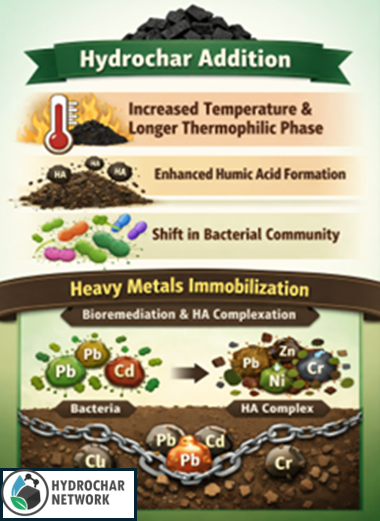
In addition, the use of hydrochar as an amendment in compost to create organic fertilizer is both a cost-effective and highly efficient approach (Pantelopoulos & Aronsson, 2026; Xu et al., 2026a). Currently, there is a growing body of research focused on the application of hydrochar in compost as an organic fertilizer for crop production and pollutant management, including efforts to mitigate greenhouse gas (GHG) emissions (Bona et al., 2022; Shan et al., 2023). For instance, Xu et al. (2026b) found that organic fertilizer amended with hydrochar reduced cumulative ammonia emissions by 45.9% in the first season and by 26.0% in the second season, compared to chemical fertilizers. Long et al. (2024) found that adding hydrochar to compost led to elevated composting temperatures, a 7.3% increase in humic acid (HA) content, and a 52.9% boost in the humic acid to fulvic acid ratio. The compost enriched with hydrochar exhibited reductions in heavy metal concentrations, specifically Zn, Cu, Pb, and Ni, by 19.2%, 36.3%, 37.8%, and 27.1%, respectively. Moreover, the incorporation of hydrochar significantly modified the structure of the microbial community. Consequently, the improved production of humic acid during composting with hydrochar aided in lowering the bioavailability of heavy metals through both bacterial bioremediation and the complexation by humic acid.
The incorporation of hydrochar as an amendment during the composting process has been shown to be an effective strategy for mitigating the bioavailability of heavy metals in soil. This approach not only helps to sequester harmful contaminants but also significantly reduces nitrogen loss, thereby contributing to a healthier and more sustainable soil ecosystem. Implementing hydrochar in composting should be considered a highly recommended practice for enhancing soil quality and fertility.
📖 References
An, R., Zelang, X., Wang, D., Liu, S., Lu, N., Ma, C., Bian, H., Sheng, L., Guan, J., 2026. Effects of biomass feedstock and hydrothermal temperature on the molecular composition and bioavailability of invasive plant-based hydrochar-derived dissolved organic matter. Water Research 294, 125497. https://doi.org/10.1016/j.watres.2026.125497
Berge, N.D., Ro, K.S., Mao, J., Flora, J.R.V., Chappell, M.A., Bae, S., 2011. Hydrothermal Carbonization of Municipal Waste Streams. Environmental Science & Technology 45, 5696-5703. https://doi.org/10.1021/es2004528
Bona, D., Bertoldi, D., Borgonovo, G., Mazzini, S., Ravasi, S., Silvestri, S., Zaccone, C., Giannetta, B., Tambone, F., 2023. Evaluating the potential of hydrochar as a soil amendment. Waste Management 159, 75-83. https://doi.org/10.1016/j.wasman.2023.01.024
Bona, D., Scrinzi, D., Tonon, G., Ventura, M., Nardin, T., Zottele, F., Andreis, D., Andreottola, G., Fiori, L., Silvestri, S., 2022. Hydrochar and hydrochar co-compost from OFMSW digestate for soil application: 2. agro-environmental properties. Journal of Environmental Management 312, 114894. https://doi.org/10.1016/j.jenvman.2022.114894
Gao, Y., Liu, Y., Zhu, G., Xu, J., xu, H., Yuan, Q., Zhu, Y., Sarma, J., Wang, Y., Wang, J., Ji, L., 2018. Microwave-assisted hydrothermal carbonization of dairy manure: Chemical and structural properties of the products. Energy 165, 662-672. https://doi.org/10.1016/j.energy.2018.09.185
Kambo, H.S., Dutta, A., 2015. A comparative review of biochar and hydrochar in terms of production, physico-chemical properties and applications. Renewable and Sustainable Energy Reviews 45, 359-378. https://doi.org/10.1016/j.rser.2015.01.050
Khan, N., Mohan, S., Dinesha, P., 2021. Regimes of hydrochar yield from hydrothermal degradation of various lignocellulosic biomass: A review. Journal of Cleaner Production 288, 125629. https://doi.org/10.1016/j.jclepro.2020.125629
Khosravi, A., Zheng, H., Liu, Q., Hashemi, M., Tang, Y., Xing, B., 2022. Production and characterization of hydrochars and their application in soil improvement and environmental remediation. Chemical Engineering Journal 430, 133142. https://doi.org/10.1016/j.cej.2021.133142
Liu, H., Basar, I.A., Nzihou, A., Eskicioglu, C., 2021. Hydrochar derived from municipal sludge through hydrothermal processing: A critical review on its formation, characterization, and valorization. Water Research 199, 117186. https://doi.org/10.1016/j.watres.2021.117186
Long, Y., Zhu, N., Zhu, Y., Shan, C., Jin, H., Cao, Y., 2024. Hydrochar drives reduction in bioavailability of heavy metals during composting via promoting humification and microbial community evolution. Bioresource Technology 395, 130335. https://doi.org/10.1016/j.biortech.2024.130335
Lucian, M., Volpe, M., Merzari, F., Wüst, D., Kruse, A., Andreottola, G., Fiori, L., 2020. Hydrothermal carbonization coupled with anaerobic digestion for the valorization of the organic fraction of municipal solid waste. Bioresource Technology 314, 123734. https://doi.org/10.1016/j.biortech.2020.123734
Martinez-Sanchez, L., Maestro-Gaitán, I., de la Rubia, M.A., Reguera, M., Mohedano, A.F., Tobajas, M., 2026. Hydrothermal carbonization and pyrolysis of sewage sludge: Plant growth effects of hydrochar and biochar. Biomass and Bioenergy 204, 108424. https://doi.org/10.1016/j.biombioe.2025.108424
Pantelopoulos, A., Aronsson, H., 2026. Organic waste and their respective hydrochars: Characteristics, carbon stability and nutrient release dynamics in soil. Journal of Environmental Management 400, 128674. https://doi.org/10.1016/j.jenvman.2026.128674
Scrinzi, D., Bona, D., Denaro, A., Silvestri, S., Andreottola, G., Fiori, L., 2022. Hydrochar and hydrochar co-compost from OFMSW digestate for soil application: 1. production and chemical characterization. Journal of Environmental Management 309, 114688. https://doi.org/10.1016/j.jenvman.2022.114688
Shan, G., Li, W., Liu, J., Zhu, L., Hu, X., Yang, W., Tan, W., Xi, B., 2023. Nitrogen loss, nitrogen functional genes, and humification as affected by hydrochar addition during chicken manure composting. Bioresource Technology 369, 128512. https://doi.org/10.1016/j.biortech.2022.128512
Suarez, E., Martinez-Sanchez, L., de la Rubia, M.A., Reguera, M., Esteban, E., Mohedano, A.F., Tobajas, M., 2025. Assessment of food waste hydrochar as a soil amendment: Effects on soil properties, plant growth and stress response. Waste Management 204, 114901. https://doi.org/10.1016/j.wasman.2025.114901
Wu, K., Gao, Y., Zhu, G., Zhu, J., Yuan, Q., Chen, Y., Cai, M., Feng, L., 2017. Characterization of dairy manure hydrochar and aqueous phase products generated by hydrothermal carbonization at different temperatures. Journal of Analytical and Applied Pyrolysis 127, 335-342. https://doi.org/10.1016/j.jaap.2017.07.017
Xu, H., Zhang, X., Chen, T., Lisha, W., Ding, H., Wang, J., Wang, H., Feng, Y., Xue, L., 2026a. Hydrochar conditioning organic fertilizer outperforms pyrochar in reducing ammonia volatilization and cost efficiency: A two-year field study. Agriculture, Ecosystems & Environment 397, 110103. https://doi.org/10.1016/j.agee.2025.110103
Xu, S., Chu, Q., Lin, J., Qin, F., Li, D., Liu, X., Xu, X., Yin, S., Chen, C., He, P., Sha, Z., 2026b. Hydrochar from rice straw as a bio-based slow-release fertilizer: Tuning temperature and oxidation for agronomic performance. Industrial Crops and Products 240, 122662. https://doi.org/10.1016/j.indcrop.2026.122662

Follow us: