

Process water (PW)
✍️ by Matheus Cavali and Gianluigi Farru
Origin and Role of Process Water in HTC
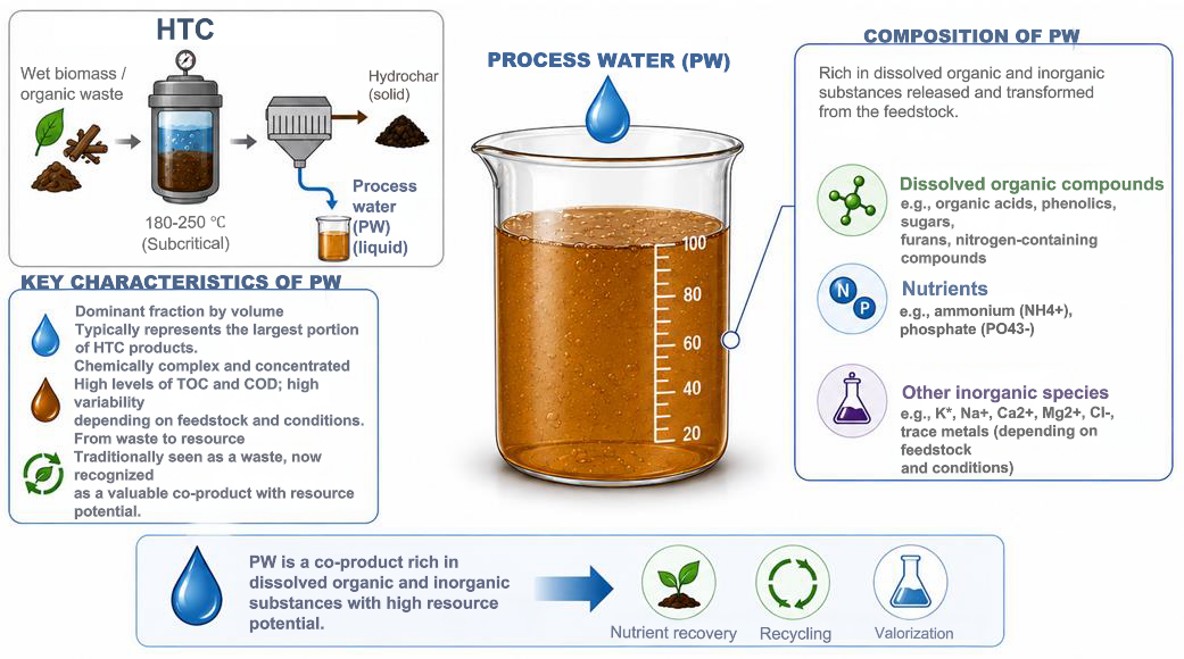
Process water (PW) is a liquid by-product generated during HTC, which involves treating wet biomass or organic waste under subcritical conditions (Boamah & Salaudeen, 2025; Ipiales et al., 2021; Taran et al., 2025). This liquid is separated from the resulting slurry by processes such as filtration or centrifugation after the reaction (Zhi et al., 2024). In terms of volume, it usually represents the dominant fraction of HTC products (Boamah & Salaudeen, 2025). Although it was traditionally considered a secondary waste product, recent studies recognize its value as a co-product rich in dissolved organic and inorganic substances released and transformed from the original feedstock (Chu et al., 2026; Langone & Basso, 2020; Mahata et al., 2026; Pei et al., 2026; Shekoohiyan et al., 2025).
Chemical Composition and Variability
The composition of PW is chemically dense and highly complex. It typically exhibits high levels of total organic carbon (TOC) and chemical oxygen demand (COD) (Chu et al., 2026; Mahata et al., 2026; Zhi et al., 2024). It is also characterized by a high nutrient content, particularly bioavailable ammonium nitrogen and orthophosphate. However, depending on the feedstock type and reaction temperature, it may also carry heavy metals and be highly saline (Chu et al., 2026; Langone & Basso, 2020; Mahata et al., 2026, Mahata et al., 2023; Zhang et al., 2025).
Environmental Risks and Need for Treatment
Treatment of HTC PW is necessary, as its direct discharge into the environment may pose significant ecological risks. PW is a highly concentrated effluent which, due to its nutrient load and toxic intermediates, can cause freshwater eutrophication and significant ecotoxicity in aquatic ecosystems (Mahata et al., 2023). The presence of inhibitory and recalcitrant compounds can further disrupt biological systems (Ipiales et al., 2021). Therefore, effective management strategies are required to reduce the organic and mineral content to acceptable levels, ensuring the HTC process remains environmentally safe and economically viable (Mahata et al., 2026).
Reuse and Valorization Pathways
The reuse and valorization of PW are important for closing loops within a circular bioeconomy, and there are several forms of these processes. The recirculation of the aqueous phase into the HTC reactor has been identified as a key strategy that serves to reduce the consumption of fresh water. The utilization of organic acids as an in-situ catalyst has been demonstrated to enhance hydrochar yields and fuel properties (Boamah & Salaudeen, 2025). Anaerobic digestion of PW represents another significant pathway, converting a high organic load into methane-rich biogas. In this context, HTC functions as a thermal hydrolysis pretreatment, solubilizing organic matter and thereby facilitating biological degradation (Ipiales et al., 2021; Kwapińska et al., 2025). In the field of agriculture, PW can be valorized as a liquid fertilizer or biostimulant, with the objective of promoting soil microbial diversity and crop yields. However, it is important to note that dilution is essential in order to mitigate phytotoxicity and salt stress (Chu et al., 2026; Mahata et al., 2026). The recovery of specific nutrients, such as phosphorus, through the process of struvite precipitation can achieve up to 99% phosphorus recovery (Chu et al., 2026).
Strategic Relevance and Future Perspectives
Overall, the status of PW from HTC has shifted from that of problematic waste to a strategic resource for bioenergy and nutrient recovery. Due to its highly variable composition, which depends strictly on the types of feedstocks used and the specific operating conditions, successful valorization requires the development of integrated, tailored management technologies. To advance HTC towards successful industrial-scale application, future efforts must prioritize detailed characterization, optimization of treatment routes and the establishment of clear regulatory frameworks. Harnessing all HTC fractions effectively, particularly the liquid phase, is key to creating a sustainable cycle of value in waste management.
📖 References
Boamah, N.N., Salaudeen, S.A., 2025. Process water from the hydrothermal carbonization of biomass: A review on the characterization, applications, and potential for future work. Journal of Water Process Engineering. https://doi.org/10.1016/j.jwpe.2025.108531
Chu, Q., Liu, X., Feng, Y., Li, D., Yin, S., Chen, C., Sha, Z., 2026. Process water from hydrothermal carbonization: from waste to liquid fertilizer and soil health amendment in circular bioeconomy. Biochar. https://doi.org/10.1007/s42773-026-00614-y
Ipiales, R.P., de la Rubia, M.A., Diaz, E., Mohedano, A.F., Rodriguez, J.J., 2021. Integration of hydrothermal carbonization and anaerobic digestion for energy recovery of biomass waste: An overview. Energy and Fuels. https://doi.org/10.1021/acs.energyfuels.1c01681
Kwapińska, M., Burke, N., Leahy, J.J., 2025. Hydrothermal carbonization and pyrolysis of dairy processing sludge for improved nutrient management in agriculture: Current state-of-the-art. Chemical Engineering Journal Advances. https://doi.org/10.1016/j.ceja.2025.100888
Langone, M., Basso, D., 2020. Process waters from hydrothermal carbonization of sludge: Characteristics and possible valorization pathways. Int. J. Environ. Res. Public Health 17, 1–31. https://doi.org/10.3390/ijerph17186618
Mahata, S., Majee, P., Bhar, R., Mondal, A., Yadav, B.K., Dubey, B.K., 2026. Decoding the Valorization of Hydrothermal Carbonization Process Water: From Chemical Complexity to Circular Waste-Management Pathways. ACS ES and T Engineering. https://doi.org/10.1021/acsestengg.5c01034
Mahata, S., Periyavaram, S.R., Akkupalli, N.K., Srivastava, S., Matli, C., 2023. A review on Co-Hydrothermal carbonization of sludge: Effect of process parameters, reaction pathway, and pollutant transport. Journal of the Energy Institute. https://doi.org/10.1016/j.joei.2023.101340
Pei, L., Wufuer, R., Duo, J., Duan, P.-G., Elendu, C.C., Yang, F., Wang, S., Liu, Y., Edna, O.U., Wang, X., 2026. Machine learning-enhanced life cycle assessment of hydrothermal carbonization for agro-waste valorization: Innovations in sustainable soil remediation. Ind. Crops Prod. 241, 122704. https://doi.org/10.1016/j.indcrop.2026.122704
Shekoohiyan, S., Sajadi, A., Moussavi, G., Heidari, M., 2025. Hydrothermal carbonization of plastic wastes and effect of influential parameters on performance and challenges: a review. International Journal of Environmental Science and Technology. https://doi.org/10.1007/s13762-025-06394-5
Taran, J., Bhar, R., Jha, H., Kuila, S.K., Samal, B., Pradhan, R., Dubey, B.K., 2025. Synthetic coalification of microalgae through hydrothermal carbonization: strategies for enhanced hydrochar characteristics and technological advancements. Bioresour. Technol. https://doi.org/10.1016/j.biortech.2025.132542
Zhang, B., Syed, N.R., Zhang, J., Ma, X., Xu, Q., 2025. A systematic review on nitrogen control during hydrothermal carbonization of sewage sludge under PRISMA guidelines. J. Anal. Appl. Pyrolysis. https://doi.org/10.1016/j.jaap.2025.106965
Zhi, Y., Xu, D., Jiang, G., Yang, W., Chen, Z., Duan, P., Zhang, J., 2024. A review of hydrothermal carbonization of municipal sludge: Process conditions, physicochemical properties, methods coupling, energy balances and life cycle analyses. Fuel Processing Technology. https://doi.org/10.1016/j.fuproc.2023.107943

Follow us: