

Co-Hydrothermal Carbonization (Co-HTC)
Exploring co-hydrothermal carbonization (Co-HTC) for enhancing process efficiency and product quality from mixed feedstocks
✍️ by Małgorzata Wilk, Klaudia Szkadłubowicz, and Łukasz Łach
Introduction
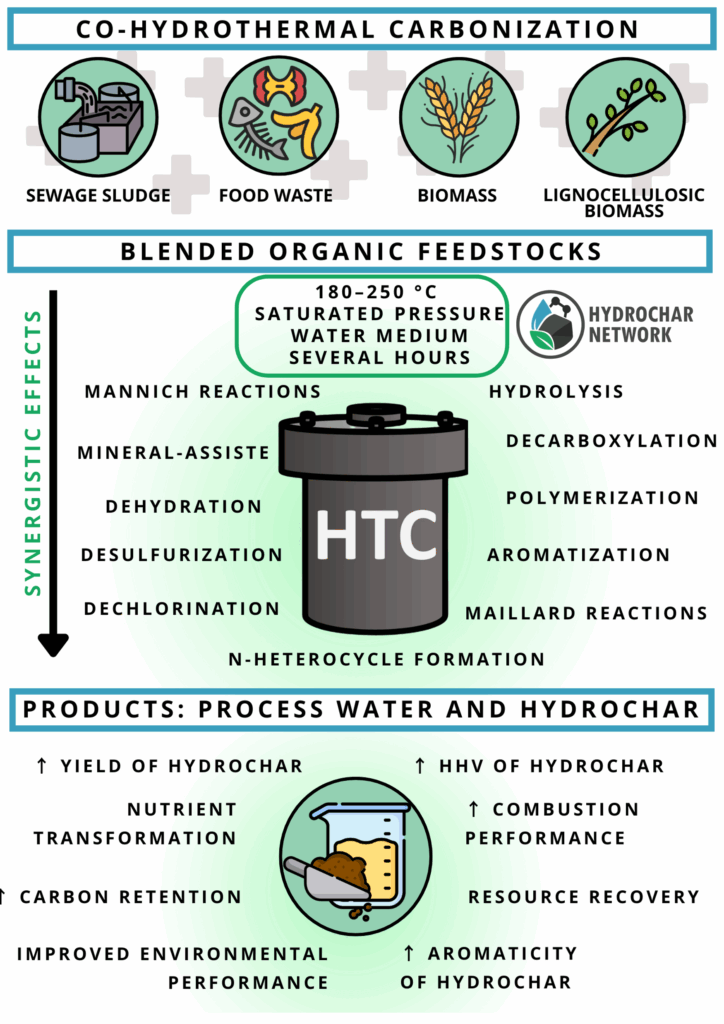
Co‑HTC is a thermochemical process that involves the simultaneous carbonization of two or more types of biomass or organic wastes under elevated temperature and pressure in the presence of water (typically 180–250 °C, saturated pressure, several hours) offering synergistic effects that can enhance the quality of both the hydrochar and process water, mainly fuel quality, yield, dechlorination/desulfurization, nutrient transformation, overall resource recovery, and environmental performance (Bardhan et al., 2021; Shanmugam et al., 2025; Wang et al., 2022; Zhang et al., 2017).
Typical feedstock combination:
- biomass and fossil-based feedstock (Fakudze & Chen, 2023)
- sewage sludge and lignocellulosic biomass, e.g., pine sawdust, bagasse, sunflower straw, etc. (Lu et al., 2021; Wilk et al., 2021)
- sewage sludge and food waste (Zheng et al., 2019)
- manure and municipal organic waste (Rosas-Mendoza et al., 2024)
Theory and Mechanisms
The underlying HTC mechanisms remain the same, but interactions between feedstocks introduce synergistic effects that can enhance product properties. The main chemical mechanisms includes hydrolysis, dehydration, decarboxylation, condensation and polymerization, aromatization, recondensation which occur in a complex, parallel, and sometimes sequential network, with the specific pathways and product distributions.
Key Parameters
The most significant factors are the feedstock composition, feedstock mixing ratio, reaction temperature, pressure, and residence time.
Synergistic effects
Co‑HTC often produces hydrochar with higher yield, carbon retention, and heating value than expected from individual feedstocks, showing clear positive synergy (Cui et al., 2024). Key mechanisms include Maillard and Mannich reactions that enhance aromatization and N‑heterocycle formation in mixed biomass systems (Shen et al., 2024). Complementary chemistry, such as minerals or organic acids, promotes desulfurization and dichlorination when biomass is combined with coal (Fakudze et al., 2022). Synergy also improves combustion performance in sludge‑ and manure‑based blends (Wilk et al., 2024; Huang et al., 2025). However, antagonistic effects can occur in mixtures with incompatible reaction pathways, such as certain biomass–fossil combinations (Fakudze & Chen, 2023).
📖 References
Bardhan, M., Novera, T.M., Tabassum, M., Islam, Md. Azharul, Islam, Md. Atikul, Hameed, B.H., 2021. Co-hydrothermal carbonization of different feedstocks to hydrochar as potential energy for the future world: A review. J. Clean. Prod. 298, 126734. https://doi.org/10.1016/j.jclepro.2021.126734
Cui, D., Zhang, B., Liu, Y., Wu, S., Wang, X., Wang, Q., Zhang, X., Fattahi, M., Zhang, J., 2024. Hydrochar from co-hydrothermal carbonization of sewage sludge and sunflower stover: Synergistic effects and combustion characteristics. J. Anal. Appl. Pyrolysis 183, 106777. https://doi.org/10.1016/j.jaap.2024.106777
Fakudze, S., Chen, J., 2023. A critical review on co-hydrothermal carbonization of biomass and fossil-based feedstocks for cleaner solid fuel production: Synergistic effects and environmental benefits. Chemical Engineering Journal 457, 141004. https://doi.org/10.1016/j.cej.2022.141004
Fakudze, S., Wei, Y., Zhou, P., Han, J., Chen, J., 2022. Synergistic effects of process-generated organic acids during co-hydrothermal carbonization of watermelon peel and high-sulfur coal. J. Environ. Chem. Eng. 10, 107519. https://doi.org/10.1016/j.jece.2022.107519
Huang, K., Zhang, X., Li, X., Liu, R., Wu, K., 2025. Exploration on physicochemical properties and combustion behaviors of hydrochar from co-hydrothermal carbonization of swine manure and tea waste. Fuel Processing Technology 278, 108345. https://doi.org/10.1016/j.fuproc.2025.108345
Lu, X., Ma, X., Chen, X., 2021. Co-hydrothermal carbonization of sewage sludge and lignocellulosic biomass: Fuel properties and heavy metal transformation behaviour of hydrochars. Energy 221, 119896. https://doi.org/10.1016/j.energy.2021.119896
Rosas-Mendoza, E.S., Alvarado-Vallejo, A., Vallejo-Cantú, N.A., Velasco-Santos, C., Alvarado-Lassman, A., 2024. Valorization of the complex organic waste in municipal solid wastes through the combination of hydrothermal carbonization and anaerobic digestion. Renew. Energy 231, 120916. https://doi.org/10.1016/j.renene.2024.120916
Shanmugam, V., Kaynak, E., Das, O., Padhye, L.P., 2025. The effects of feedstock types and their properties on hydrothermal carbonisation and resulting hydrochar: A review. Curr. Opin. Green Sustain. Chem. 53, 101024. https://doi.org/10.1016/j.cogsc.2025.101024
Shen, Q., Zhu, Xianqing, Peng, Y., Xu, M., Huang, Y., Xia, A., Zhu, Xun, Liao, Q., 2024. Structure evolution characteristic of hydrochar and nitrogen transformation mechanism during co-hydrothermal carbonization process of microalgae and biomass. Energy 295, 131028. https://doi.org/10.1016/j.energy.2024.131028
Wang, Q., Wu, S., Cui, D., Zhou, H., Wu, D., Pan, S., Xu, F., Wang, Z., 2022. Co-hydrothermal carbonization of organic solid wastes to hydrochar as potential fuel: A review. Science of The Total Environment 850, 158034. https://doi.org/10.1016/j.scitotenv.2022.158034
Wilk, M., Śliz, M., Czerwińska, K., Gajek, M., Kalemba-Rec, I., 2024. Improvements in dewaterability and fuel properties of hydrochars derived from hydrothermal co-carbonization of sewage sludge and organic waste. Renew. Energy 227, 120547. https://doi.org/10.1016/j.renene.2024.120547
Wilk, M., Śliz, M., Lubieniecki, B., 2021. Hydrothermal co-carbonization of sewage sludge and fuel additives: Combustion performance of hydrochar. Renew. Energy 178, 1046–1056. https://doi.org/10.1016/j.renene.2021.06.101
Zhang, X., Zhang, L., Li, A., 2017. Hydrothermal co-carbonization of sewage sludge and pinewood sawdust for nutrient-rich hydrochar production: Synergistic effects and products characterization. J. Environ. Manage. 201, 52–62. https://doi.org/10.1016/j.jenvman.2017.06.018
Zheng, C., Ma, X., Yao, Z., Chen, X., 2019. The properties and combustion behaviors of hydrochars derived from co-hydrothermal carbonization of sewage sludge and food waste. Bioresour. Technol. 285, 121347. https://doi.org/10.1016/j.biortech.2019.121347

Follow us: